Unfortunately, I haven’t managed to get my hands on a Pocket 4P yet, but with the CTLs of D-Log 2 and D-Gamut 2, perhaps I can have an early glimpse into the colour science of DJI’s new era.
D-Log 2
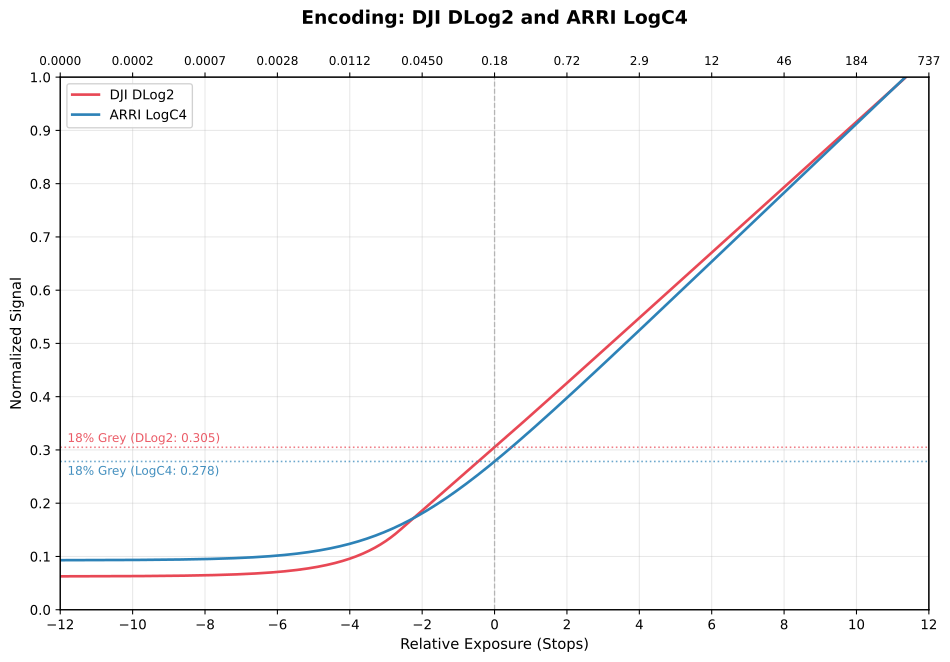
On the Pocket 4P, the main camera uses an OV50X sensor featuring Lofic technology. To take full advantage of the high full-well capacity that Lofic brings, DJI is debuting an entirely new Log curve on this model: D-Log 2.
D-Log offers an encoding upper limit of 4200% reflectance, whereas D-Log 2 reaches a staggering 47500%. This even surpasses LogC4’s 46980%, giving D-Log 2 generous headroom for highlight imagination with Lofic.
D-Gamut 2
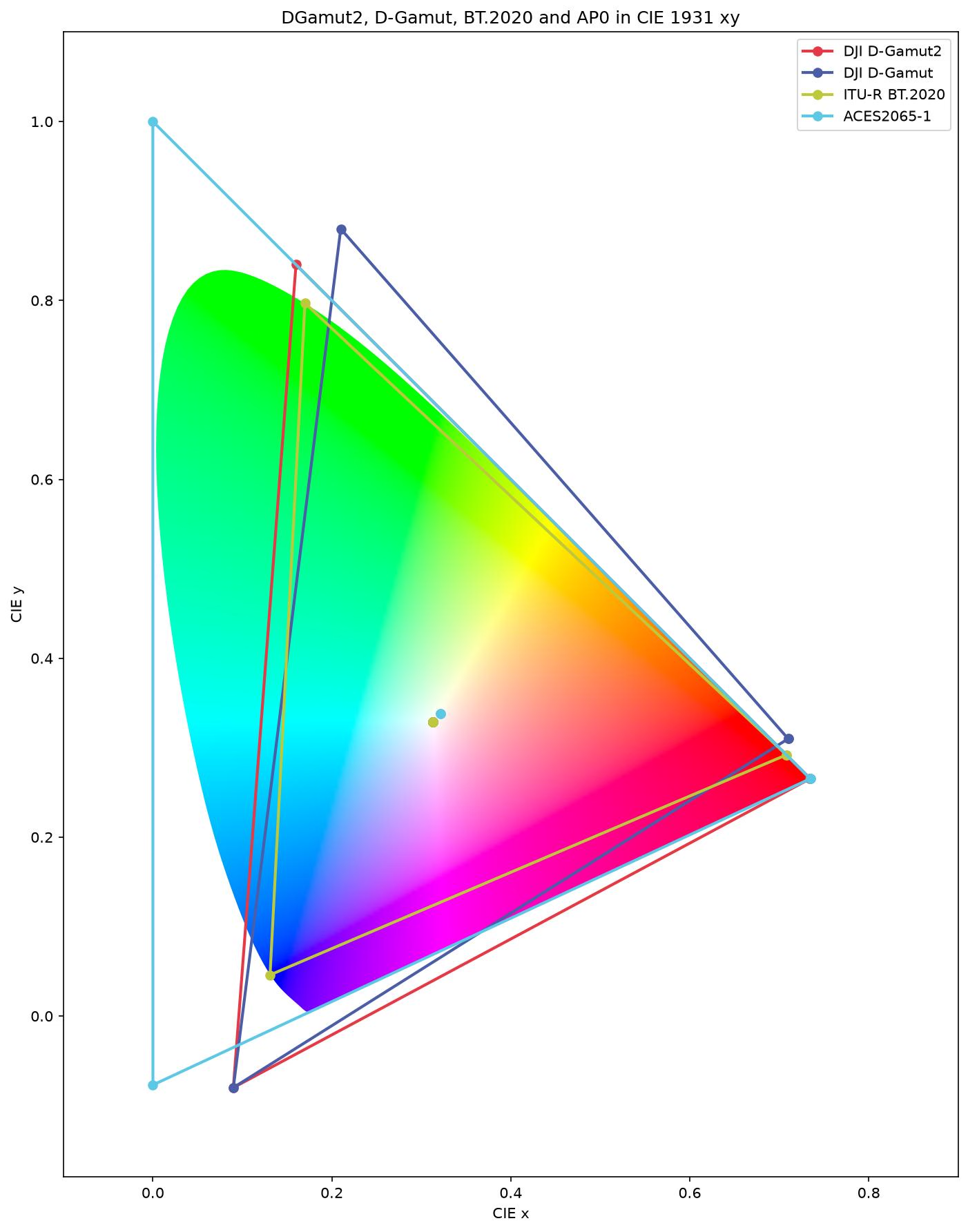
Alongside D-Log 2 comes a new colour space: D-Gamut 2. By comparison, many manufacturers who are new to Log often choose the BT.2020 primaries directly. For HDR output, this leaves almost no headroom in chromaticity, and the colour gamut in the blue region is rather small. If the output colour space is P3, the original D-Gamut is already a decent encoding space, but its shortcoming is that it cannot fully cover BT.2020. D-Gamut 2 remedies this. While sharing the blue primary coordinates with D-Gamut, it achieves complete coverage of BT.2020 by shifting the positions of the red and green primaries.
Additionally, the red and green primary coordinates of D-Gamut 2 lie on the boundary of ACES 2065-1, which significantly reduces out-of-gamut situations when converting into an ACES workflow.
A Peek through the Vivid LUT
On DJI’s official website, the LUTs for converting D-Log and D-Log 2 to Rec. 709 each come in two versions: the standard one and a Vivid version. According to customer service, the Vivid version adds some contrast and saturation on top of the base conversion.
By examining the curves of neutral input and output for these LUTs, we can see that the standard and Vivid versions have an intersection point. The Vivid version produces brighter highlights and darker shadows, which aligns with ‘having higher contrast’.
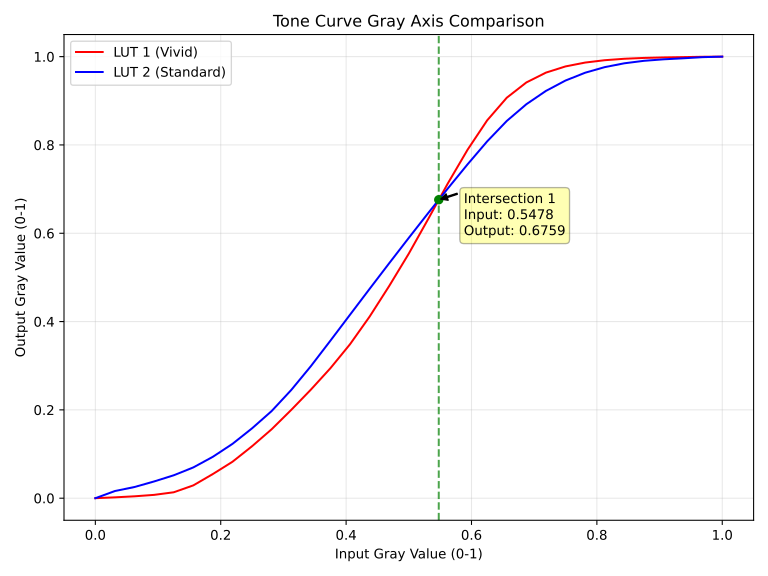
If the LUTs for D-Log and D-Log 2 are produced using the same gamut compression and tone mapping algorithms, the code value at this intersection point should correspond to a similar or identical linear light level. For D-Log, the intersection code value is 0.5478, with the linear light input at about 72% reflectance. In the D-Log 2 LUT, the intersection code value is 0.4264, or about 436 in 10-bit. From this we can guess that the code value for 72% reflectance input in D-Log 2 is around 436. When the exact formula for D-Log 2 was later obtained, the calculation gave an answer of 435.
Exposure Consistency
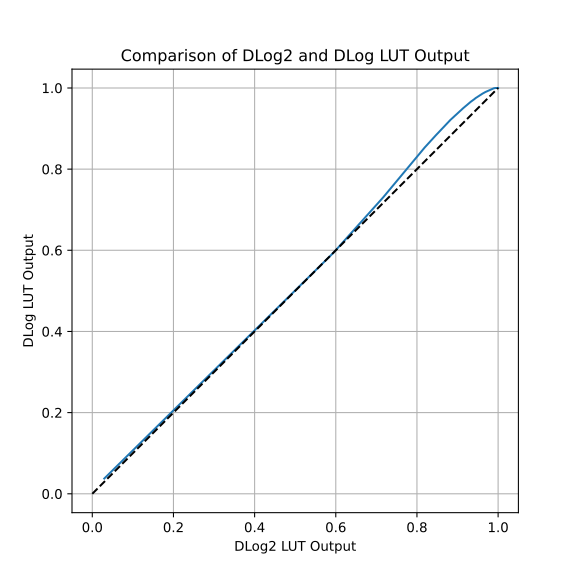
When using footage shot with a mix of D-Log and D-Log 2, can we achieve consistent exposure after applying their respective LUTs?
Assuming the camera hardware is perfectly calibrated, we uniformly sample the 0–47500% reflectance range, encode the samples using D-Log and D-Log 2 respectively, and then apply the corresponding LUTs. If the resulting code values form a plot that lies very close to the diagonal line, it shows that the two Log curves can maintain a high degree of exposure consistency after conversion.
However, because D-Log 2 has over three stops more highlight range than D-Log, the D-Log 2 conversion LUT likely applies a stronger roll-off to preserve highlights, making the restored image slightly darker in the highlight region than that of D-Log. The rest of the image can maintain high exposure consistency. The Vivid LUTs also exhibit similar consistency, but the LUTs must not be mixed. For multi-camera matching, it is still recommended to convert everything into an ACES workflow rather than relying on LUTs for colour reproduction.
If I manage to get a Pocket 4P, or if I still have enough interest by then, there may be some more in-depth experiences and analyses.
Code for generating the charts in this article can be found on Github.