High-Fidelity Compressed DNG
In PureRAW 6, DXO introduced a new high-fidelity compressed DNG file format. It claims to compress DNG file sizes down to 1/4 of a linear DNG while remaining visually lossless, with an uncompressed linear DNG being roughly 4 MB/MP in size. Of course, “visually lossless” is a rather vague concept, so we still need to look at exactly what it does.
DXO has already written about this in great—and generous—detail in their technical article, and below I’ll do some analysis based on the specific implementation details.
Pre-Processing
DXO’s PureRAW is itself a piece of software that “pre-processes” RAW files. Its main function is to use DXO’s advanced demosaicing and denoising algorithms to replace the front-end algorithms of other RAW processing software. As a result, the DNG files saved by this software are “linear DNGs” that have already been through demosaicing and denoising, rather than “Bayer RAWs” in the traditional sense.
A linear DNG has already been demosaiced and contains a full-size three-channel image, with three times as many pixels as the original. At the same time, the denoised image has an advantage in the subsequent encoding and compression stage.
Dynamic Range Compression
DXO states that in the linear light data recorded by a RAW file, the brighter the part, the lower its information density. This is because the shot noise in an image follows a Poisson distribution, with its standard deviation growing with the square root of the signal strength.
- Shadows: weak signal, low noise—every single ADU may carry real detail, and the precision provided by a high bit depth is necessary.
- Highlights: strong signal, but large noise too—a high-bit-depth linear recording doesn’t provide any more useful information.
By applying a companding function—using a non-linear curve that approximates a square root—a variance-stabilising transform is performed on the linear intensity. After the transform, the noise is approximately variance-stabilised across the entire dynamic range, allowing image data to be stored at a lower bit depth while maintaining visual quality.
Specifically, DXO uses a piecewise function that is linear at low code values and a square root function for the remainder, compressing the 16-bit data output by DXO PureRAW’s pre-processing model down to 10-bit.
DNG supports storing non-linear data: by placing a mapping lookup table in the LinearizationTable tag, the decoder can use this table to restore the non-linear data back to linear data. DXO stores a complete set of 1024 points, mapping from the 0-1023 range back to the 0-65535 range.
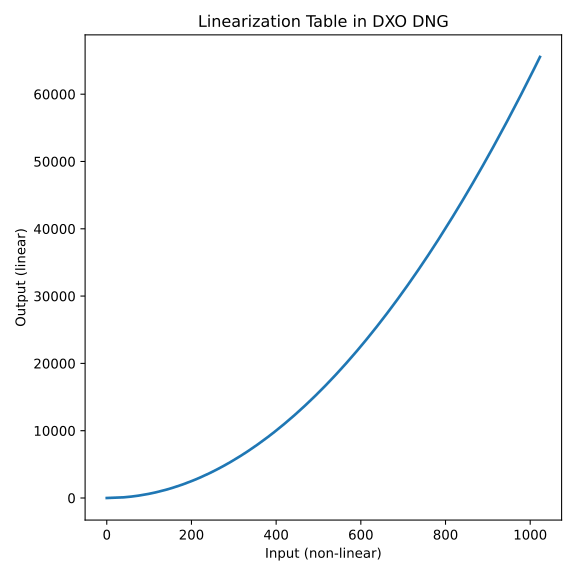
The curve in the figure shows the mapping relationship from the compressed 10-bit code values (horizontal axis) back to the 16-bit linear data (vertical axis); during compression, the inverse function is used.
JPEG-XL Efficient Compression
This is a feature newly added in the DNG 1.7.0 specification, encoding images using the advanced encoding format JPEG-XL. This encoding method is highly efficient in both lossless and lossy modes. Its lossless mode in particular is the best among the several advanced image encoding formats, clearly outperforming AVIF, while its lossy mode also offers very high compression efficiency for photographic content.
Specifically, DXO chose compression parameters very close to lossless: a distance of 0.01 (where 0 is lossless in JXL) and an effort of 3 (similar to the speed parameter in AVIF, with a range of 0-7).
Adobe DNG Converter can be used as a command-line tool. Through the -jxl_effort and -jxl_distance parameters you can specify JPEG-XL’s compression parameters. The current version (18.2.2) only allows specifying compression parameters in -lossy mode, and this mode also outputs a Linear DNG rather than a Bayer RAW. The file obtained using the same parameters is much larger than DXO’s DNG, possibly because it lacks the earlier dynamic range compression and denoising processing.
EXE -lossy -jxl_effort 3 -jxl_distance 0.01 file.ARWThe Results
After processing an image from the Sony a7C2 (33MP), the file size is roughly 1/2 of Sony’s own losslessly compressed RAW, between 18-20MB. Compared to a case with only bit compression, it’s about 1/3, achieving fairly good compression efficiency—and this is on top of a linear RAW whose pixel count has tripled. For comparison, a 16-bit Linear DNG compressed with JPEG-XL using the same parameters is around 45 MB.
Importing the original RAW and this DNG into ACR, the first thing you notice is that DXO’s DNG can no longer use camera-matched profiles—only Adobe Color is available—and the white balance values have changed somewhat. With Adobe Color used in both cases and optical correction turned off, you can barely tell any difference whether you zoom in closely or compare globally; in cases with more noise, DXO’s denoising mechanism kicks in and does a bit better than a RAW with nothing done to it.
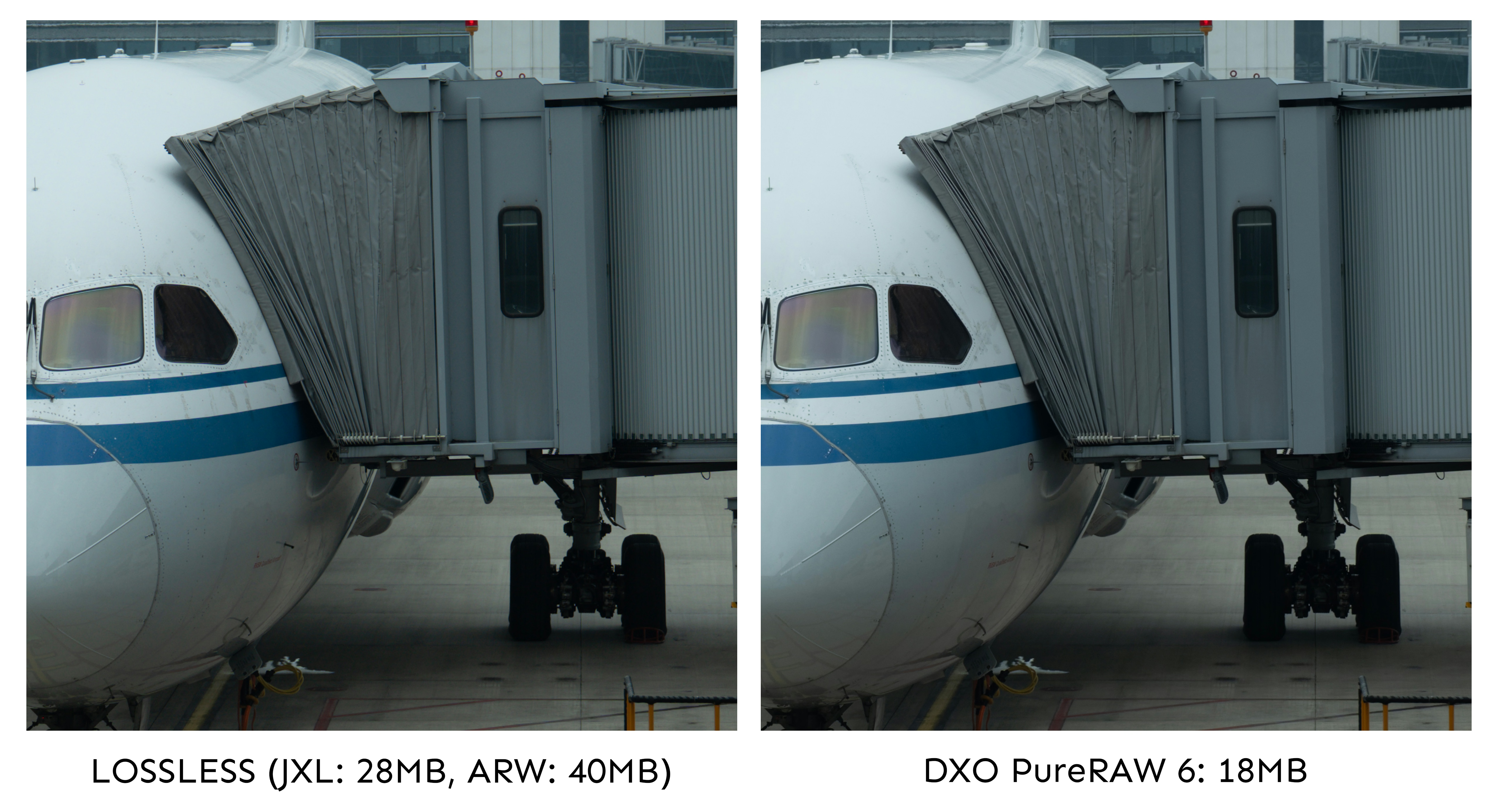
When this zoomed-in image was uploaded to the blog’s object storage, it was compressed once more with AVIF at quality 85, so the difference should be even harder to spot.